SFP students sharpen research skills during scientific field trip
June 5, 2026
A wide smile appeared on Avery’s face this spring when she realized she had caught an aquatic macroinvertebrate in her fishing net.
Dozens of Science Focus Program (SFP) classmates shared Avery’s elated reaction during their research-based field trip to Conestoga Lake. Students in grades 9-12 gained insights about measuring and studying water quality through their in-person experiences. They also acquired essential field research skills that they will use both at SFP and in their future careers.
Avery and Jordyn said coming to Conestoga Lake was one of the highlights of their senior years. They wore wading boots along the shoreline as they dipped their nets into the water for their tests. Both said the trip added an important layer to their deep scientific knowledge.
“This is for sure an unforgettable experience,” Jordyn said. “Just coming here and learning about this in person is so much cooler than learning it in a classroom. I feel like I can understand it better and see it better. It all helps with the learning process in general.”
“It’s super cool,” Avery said. “It’s a really valuable experience. Lakes are everywhere, and most of them in Nebraska are not natural, so being able to see all of the factors that make those lakes healthy is really neat.”

Adam Sutton oversaw their fishing achievements with excited words of encouragement. Sutton is a youth environmental educator with the Lower Platte South Natural Resources District (LPSNRD), which was one of the SFP’s community partners for the field trip. He watched students haul in crayfish, tadpoles, damselflies, green sunfish and cricket frogs from the lake, which indicated a good water quality level.
Sutton leads many educational programs throughout the LPSNRD’s six-county footprint. He said his top goal is to spark interest in nature with fun hands-on activities.
“I think that’s probably the best thing about this,” Sutton said. “You can see that wonder in their eyes when they’re looking through the net. It looks like genuine excitement when you see them with the nets in hand, catching things.”
SFP students spent more than four hours reeling in water quality facts from local experts. Representatives from the LPSNRD, Nebraska Department of Water, Energy and Environment (NDWEE), University of Nebraska-Lincoln Water Sciences Laboratory and The Flatwater Group led sessions at Conestoga State Recreation Area.
SFP Administrator Lindsey Roy said she was pleased with the community engagement that happened during the field trip. SFP teachers Emily Seifferlein and Mitch Bern contacted several local and state agencies to gauge their interest in helping students. All gave thumbs-up to the idea and began planning for their activities.
“Our program has done similar trips in the past in partnership with the Lower Platte South NRD,” Roy said. “This is the first time we’ve had so many partners doing this with us. Emily Seifferlein and Mitch Bern have made additional connections and increased the intentionality of the trip.”

Avery and Jordyn began their morning learning how a recent restoration project at Conestoga Lake has helped the local ecosystem. Gordon Coke of The Flatwater Group told students how sediment inflows had caused the lake to lose one-third of its original volume. The extra dirt affected Conestoga Lake’s water quality, leading to a reduction in fish species.
Workers removed 600,000 cubic yards of sediment from the lake over three years. They also added sediment traps, formed a shallow wetlands area and built a dozen underwater islands as fish habitats. Largemouth bass, bluegill, crappie, channel catfish, walleye and sunfish now swim in healthy water environments.
Jordyn said she was amazed at the amount of planning that went into the project.
“I’ve definitely learned a lot about how much it takes to make a lake healthier,” Jordyn said. “It takes a lot of power and people and resources.”
Avery and Jordyn gained additional facts from a fishing pier later in the morning. NDWEE employees showed them how they use a water quality meter to monitor hundreds of Nebraska lakes and streams. The cylinder-shaped device records the temperature, oxygen saturation, dissolved oxygen, conductivity and pH levels of water.
After paddling on the lake in a kayak, Avery and Jordyn’s group finished the day by investigating the Know Your Well groundwater testing program. Know Your Well is funded by the Nebraska Environmental Trust and supported by the University of Nebraska-Lincoln Water Sciences Laboratory.
Sara Brock-Contreras, Anni Poetzl and Rachael Herpel led groups throughout the day. Brock-Contreras is a graduate research assistant at UNL, Poetzl is an assistant extension educator with UNL Extension, and Herpel is the assistant director for the Daugherty Water for Food Global Institute and Nebraska Water Center.
The trio showed students how to collect proper groundwater samples. They also taught them how to test the samples for nitrates, pesticides and metals such as copper and manganese. This data can help determine if the groundwater is safe to drink.
Roy said the science-based conversations provided students with the sources they will need to become successful field researchers.
“This trip gives kids a wide range of ideas of the types of data collection and natural resource monitoring methods that they could then apply in their own research projects in their junior or senior years,” Roy said. “It also gives them connections to these experts as potential advisors for their projects in the future.”
Sutton said he was impressed with the passion for nature that SFP students displayed during the day. He felt these types of field trips would benefit everyone in both the short and long term.
“There are a lot of reasons why I have fun doing this,” Sutton said. “From a personal level, I just enjoy it myself, but from a deeper level, I feel like it does make a difference for the future of our natural resources.”
Do you have a story idea? Share it with the LPS Communications Team by filling out this form!
Published: June 5, 2026, Updated: June 8, 2026
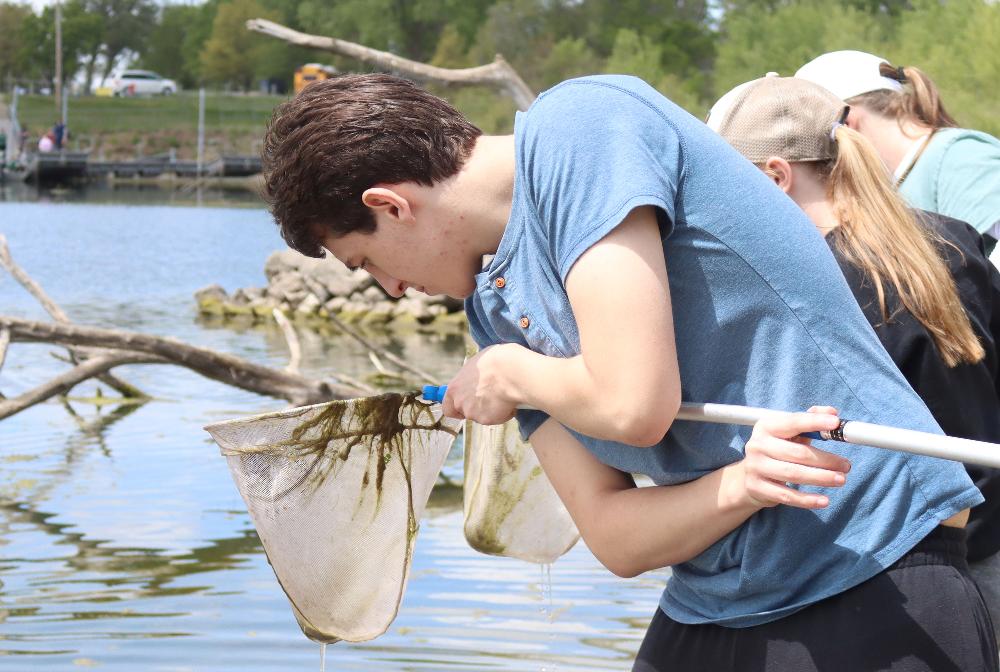
A Science Focus Program student takes a close look inside a fishing net to see if he has caught any aquatic macroinvertebrates at Conestoga Lake. SFP students in grades 9-12 sharpened their field research skills by examining the lake's water quality.